Rupee hits nearly 11-month low against US dollar
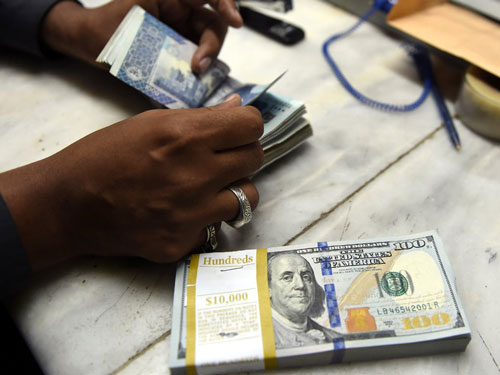
KARACHI – The dollar rose 0.65% or Rs1.08 and hit an almost 11-month high against the Pakistani rupee in the interbank market on Wednesday.
According to data released by the State Bank of Pakistan (SBP), the US dollar reached Rs 166.28 while it closed at Rs 165.20 against the rupee a day earlier.
An independent financial research firm, Capital Stake, said the dollar closed above Rs 166 for the last time in September 2020.
The massive depreciation of the rupee reflects the strengthening of the greenback due to the economic conditions of the country.
Interbank closing #Change rate for today: https://t.co/G1mje4p9zh pic.twitter.com/oGlpCjY3SA
– SBP (@StateBank_Pak) 25 August 2021
On Tuesday, the central bank received $ 2.7 billion from the International Monetary Fund (IMF) as part of its Special Drawing Rights (SDR) allocation to combat the economic fallout from the Covid-19 pandemic.
Despite significant inflows, the local currency is under pressure.
The IMF has transferred funds to the tune of $ 2.77 billion to Pakistan to help the country increase its foreign exchange reserves and address the economic challenges caused by the Covid-19 pandemic.
IMF Managing Director Kristalina Georgieva announced the launch of the largest Special Drawing Rights (SDR) allocation in the organization’s history, approximately $ 650 billion.
Statement by Kristalina Georgieva
âThe allowance is a big boost for the world and, if used wisely, a unique opportunity to tackle this unprecedented crisis.
âThe SDR allocation will provide additional liquidity to the global economic system – supplementing countries’ foreign exchange reserves and reducing their dependence on more expensive domestic or foreign debt. Countries can use the space offered by the SDR allocation to support their economies and step up their fight against the crisis.
âSDRs are distributed to countries in proportion to their IMF quotas. This means that around US $ 275 billion will go to emerging and developing countries, of which low-income countries will receive around US $ 21 billion, or the equivalent of 6% of GDP in some cases.
âSDRs are a valuable resource and the decision on how best to use them rests with our member countries. For SDRs to be deployed for the benefit of member countries and the global economy, these decisions must be prudent and well-informed.
âTo support countries and help ensure transparency and accountability, the IMF provides a framework to assess the macroeconomic implications of the new allocation, its statistical treatment and governance, and how it might affect debt sustainability. The IMF will also provide regular updates on all SDR holdings, transactions and exchanges, including a follow-up report on the use of SDRs in two years.
âTo amplify the benefits of this allocation, the IMF encourages the voluntary routing of certain SDRs from countries with strong external positions to countries most in need. Over the past 16 months, some members have already pledged $ 24 billion, including $ 15 billion from their existing SDRs, to the IMF’s Poverty Reduction and Growth Fund, which provides concessional loans to low income countries. This is just the start, and the IMF will continue to work with its members to build on this effort.
âThe IMF is also engaging with its member countries on the possibility of a new Trust for Resilience and Sustainability, which could use channeled SDRs to help the most vulnerable countries achieve structural transformation, especially to deal with climate-related challenges. Another possibility could be to channel SDRs to support lending by multilateral development banks.
âThis SDR allocation is a critical part of the IMF’s larger effort to support countries during the pandemic, which includes: $ 117 billion in new financing for 85 countries; debt service relief for 29 low-income countries; and policy advice and capacity development support to more than 175 countries to help ensure a strong and more sustainable recovery.
Read more: https://pakobserver.net/imf-allocations-to-take-forex-reserves-to-historic-high-level-baqir/