The IMF lost a bet: why repay them?
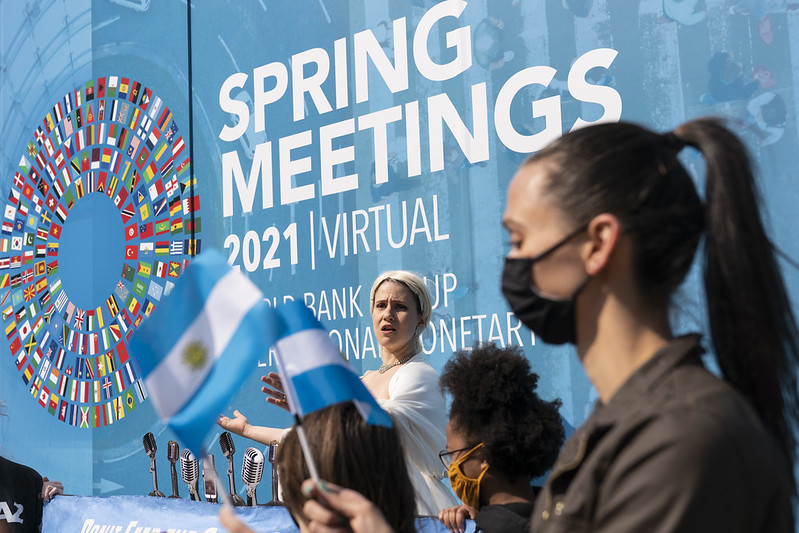
This article originally appeared in Spanish on Revista Mugica.
Translation by Néstor David Pasteur.
WEconomists tend to view neoliberalism as a set of economic policies, the disastrous effects of which we know well in Argentina, and that to transcend it, it is enough to adopt macroeconomic policies. Neoliberalism, however, is much more than that. It is a system of political and economic domination which has profoundly transformed daily life in the capitalist countries. Social, political, judicial, media and economic structures have undergone almost irreversible transformations which guarantee the current financial imperialism to which marginalized countries have been subjected, despite the election of populist governments. There is also a strong ideological component instilling commonly held views that emphasize staunch individualism â that is, ârun awayâ âand an extremely conservative fiscal outlook.
While certainly not the only, the International Monetary Fund (IMF) is perhaps the best-known support of this new world order of financial imperialism. The conditions of the IMF loans available to member countries in crisis are still neoliberal economic reforms, financial and trade liberalization; privatization of state enterprises, public services and social security; deregulation of labor ( “flexibility”); and other reforms to give more power to international capital at the expense of workers and the state.
The ongoing negotiations between the government of Alberto Fernández and the IMF are a key example of the sordid elements of this system of domination. The granting of an IMF loan the government struggling to Mauricio Macri has led to a number of serious irregularities that require a discussion of its legitimacy, it must be repaid and, if so, on what terms.
The multiple irregularities of the IMF loan
When the international financial markets ended the first quarter of 2018, ending the reckless debt incurred by the government Macri, Argentina was essentially confronted with the failure of reality. To avoid this and the inevitable crisis that would ensue, Macri has desperately turned to the IMF. The IMF agreed to help, but doing so has committed multiple irregularities, violating its own statutes and standards to accommodate a government “friend” Trump and financial imperialism.
What are these irregularities and violations? First, the loan amount allowed in a stand-by agreement was 57 billion ($ 50 billion in the original agreement, and then increased a few months later for $ 5.7 billion in a second agreement). According to the IMF Articles of Agreement, the maximum amount of a typical stand-by loan must not exceed 145 percent of the annual tranche, and the total amount can not exceed 435 percent of the slice. Payment of Argentina is 3 187.30 SDR, which in dollar equals about $ 4 460. That is to say that the loan represented a total of about 1 100 percent payment, well above the maximum limit established in the statutes.
Second, the amount of the IMF loan managed by the Macri government exceeded 60% of its solvency, which is also prohibited by IMF regulations stipulating that a country’s aid cannot exceed 50% of the available funds allocated to this. end.
Third, the IMF agreed to lend money to the Macri government even when its own experts – in successive reports prepared before each tranche of the loan was disbursed – judged Argentina’s debt to be very unlikely to fall. ‘be sustainable. In view of this analysis, it would have been appropriate for the IMF, before granting such an exceptional loan, to ask Argentina to restructure its private debt, a strategy that the IMF had implemented in other countries. Even so, this was not the case in Argentina. Rather, the opposite has happened: faced with the reality of unsustainable debt and virtual default, the IMF lent an additional $ 57 billion.
Fourth, as the IMF disbursed loans to the Macri government, it became evident that the disbursed funds were used to finance capital flight, as happened in the late 1990s. Article VI of the statutes of the IMF expressly prohibits the granting of loans for this purpose. Nonetheless, the IMF continued to disburse every tranche of the loan, effectively financing the flight of capital.
Alberto Fernández himself told the IMF delegation he met as a candidate in 2019, according to the press release regarding the meeting. In an interview with CNN, Macri even admitted that the IMF loan was made so that foreign investment funds could abandon their holdings in Argentine bonds and take their money abroad. Capital flight and the active role of the IMF in this process are documented in a survey by the Argentine Central Bank. The report was the basis for prosecution, which unfortunately seem to have been forgotten in some law firms.
Finally, Mauricio Claver Carone, the current president of the Inter-American Development Bank and US representative on the IMF board under the Trump administration, bluntly said Macri’s loan to the IMF was a political favor. , since Trump was betting on Macri’s stay in power. In a recent interview, Macri himself said that the IMF loan was to secure a âtransition,â that is, to get through 2018 and 2019 smoothly and win the presidential elections. In other words, it was a direct contribution to Mauricio Macri’s presidential campaign.
As if that weren’t enough, in a recent interview Macri had the nerve to claim he would have fixed the “underlying problem” in five minutes. Many, of course, interpreted this as sarcasm, but in reality it was a very serious admission as Macri also said that the nearly $ 20 billion regime currently maturing in 2022, for example, was deliberately agreed with the IMF. , for fear of a populist victory. In other words, it explicitly recognizes that the infeasibility of the payment plan was intended to prevent the next administration if not Macri from, or another administration sympathetic to the IMF.
And now?
TThe IMF has strongly bet on keeping the Macri government in power by committing multiple flagrant irregularities and violations of its statutes. They played and lost. One might assume that Argentina is in a strong position to negotiate with the IMF. Does the loan have to be repaid? And if so, under what conditions?
The government has sent mixed and, in some cases, worrying signals on this matter. It would seem that the ultimate expectation is the elimination of interest charged to countries which receive loans in excess of the capacity allocated to them and extensions of payment terms. Nothing has been said about the conditions that the IMF normally imposes on any agreement or about the gross irregularities committed. In fact, the fiscalism demonstrated by the Ministry of the Economy, as highlighted by Vice-President Cristina Fernández de Kirchner, is a worrying sign in this direction.
The IMF maintains that a moratorium, the elimination of interest charges or an extension of the term beyond the decade is legally prohibited. Nonetheless, the IMF repeatedly violated its own standards for granting the loan. Now that it’s time to negotiate the refund, can’t they be flexible? The status is flexible when granting loans to governments aligned with economic imperialism, but not when it is time to repay those loans.
We believe that the conditions are ripe for a difficult negotiation, taking a stand based on the irregularities committed throughout the process. Regarding the IMF, do we have to pay? Plagued by irregularities, the IMF loan was a gamble on Macri’s retention in power and an explicit attempt to influence Argentine democracy. Fortunately, the IMF and Macri lost. Since when must the Argentine government and people assume responsibility for the losses caused by such a bet?
Faced with the inflexibility of the IMF, two options present themselves. The first is straightforward: not to pay the losses generated by their failed bet. The second is to pay, but to unilaterally decide on the terms of repayment. For example, zero interest (as a deduction) and a 25-year repayment plan with a six-year moratorium. As they say in Hollywood, take it or leave it.
Finally, even when it comes to paying, it is necessary to check capital flight and loan conditions. The people of Argentina should not have to shoulder a huge debt created by a few and not benefiting the majority. The Central Bank calculated the amount of capital flight. Barely 10% of buyers of currencies (referring to individuals) bought $ 47 billion, or 63% of the total purchase of this type of asset. It is essential to know the first and last names of these fugitives, the process of the flight of capital and whether this has been duly reported to the treasury. Based on this information, a complete debt assessment process can begin, along with how to proceed.
It is also essential to engage in a substantive debate, with criminal charges at the center – which the executive should push to continue sleeping with a clear conscience – against those who not only negotiated the loan, but who have publicly admitted to accepting it. deliberately conditions that would hamper future administrations through explicit violations of the constitution. It is impossible to generate the necessary consensus and reverse the allegedly unfavorable correlation of forces without dealing with urgent conflicts.
If we really want economic independence, social justice and political sovereignty, then these things should be affirmed because nobody is going to betray them. The time has come to begin to move away from economic imperialism imposed elsewhere and exercised by local politicians adhering to foreign business interests.
Alan ciblis is an economist and professor of political economy at the Universidad Nacional de General Sarmiento in Buenos Aires, Argentina.
German Pinazo is Professor and Director of the Political Economy Department of the Universidad Nacional de General Sarmiento in Buenos Aires, Argentina.