WSU researchers win $1.4 million grant to mitigate impact of road salt | Area
Since the turn of the 20th century, road salt has been saving lives on highways across the country, but its abundant use also has significant consequences for wildlife and human health.
An interdisciplinary team of researchers from Wichita State University is working to reduce the pollution and damage caused by road salt. The project – ECO-CBET: Convergent Electrolysis-Electrodialysis System (CEES) to Curb Urban Chloride Pollution by Eco-friendly Road Deicing and Waste Salt Upcycling – recently received $1.4 million from the National Science Foundation (NSF).
Wichita State and Iowa State are collaborating on the project, with each university receiving $700,000 of the overall project funding.
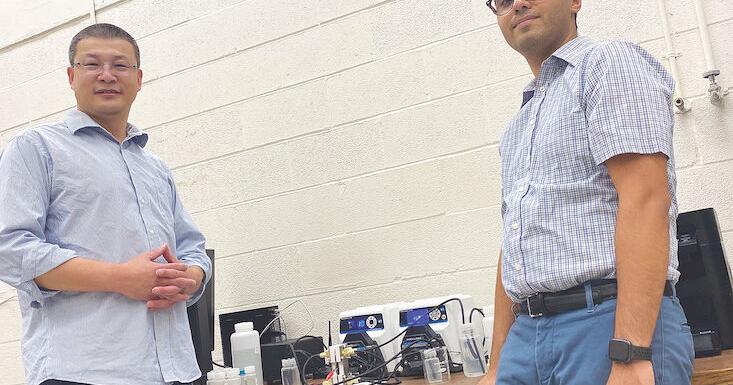
Dr. Shuang Gu, an associate professor of mechanical engineering, is the principal investigator for the Wichita State award, while Dr. Wenzhen Li, a professor of chemical and biological engineering, leads the Iowa State effort.
“We have noticed over the past 50 years that the United States has exponentially increased the application of road salt,” Dr. Gu said. “We can buy road salt anywhere in 20 or 50 pound bags to thaw the roads and travel safely, and there’s nothing wrong with that. He saves people’s lives. But we never pay attention to the implications of road salt.
Once the salt is washed off the roads, it seeps into groundwater and other freshwater sources, harming nearby ecosystems and humans. In 2019, the United States applied 24.5 million tons of road salt — or 43% of total national salt consumption — which translates to about 160 pounds of road salt per person.
“The sad side of road salt is that most of the salt ends up in ditches, streams, lakes or reservoirs, which leads to a series of ecological and health problems,” Gu said.
When salt seeps into freshwater sources, it alters the water chemistry and leads to a decrease in the health of wildlife, especially amphibians.
“A 2015 study by the U.S. Geological Survey found that 84% of surveyed urban waterways experienced a steady increase in salt concentration, and 29% exceeded the federal safety guideline for at least part of the year,” Gu said. “It affected the growth and reproduction of amphibians.”
For humans, the negative consequences of increased salt intake have been studied for decades. The Federal Drug Administration recommends no more than 2.3 grams of salt per day, but Americans consume an average of about 3.4 grams per day. The extra salt seeping into groundwater is of concern, Gu said.
“We already eat too much salt, and we don’t want drinking water to add more,” he said. “Salt accumulated in nearby bodies of water ends up in the drinking water system.”
This is especially true for people who have well water or private water systems, who make up about 15% of the US population. Public water systems, Gu said, have a little more control to filter salt from the drinking water supply.
An alternative de-icer: sodium formate
“We can’t stop people from using road salt because we need it for traffic safety,” Gu said. “But why not replace the polluting road salt? Sodium formate is an alternative and environmentally friendly deicing agent.
The CEES team’s NSF abstract proposes that it will “initiate and establish a convergent electrolysis-electrodialysis system as a viable engineering solution that can effectively mitigate the complex environmental, ecological and economic issues associated with increasing pollution from chlorides in urban water bodies, while reducing carbon dioxide emissions.
“We can replace this road salt with an environmentally friendly de-icing agent,” Gu said.
In addition to replacing harmful road salt, the CEES team will work at the same time to recycle waste salt, when manufacturing the ecological de-icing agent.
According to the abstract, “The system is designed to directly reduce chloride discharge by recycling waste salt into the regeneration stream of city water softeners, and to stop continued chloride pollution by passing de-icing agent from polluting road salt to eco-friendly sodium formate.
Therefore, CEES has a dual effect on chloride mitigation: reducing one source of salt pollution and avoiding another source of salt release.
“Sodium formate can be broken down by mother nature and bacteria,” Gu said. “It doesn’t give us any major complications. It is a benign, safe and effective de-icing agent.
With all the health and environmental benefits of sodium formate, the question arises: why would we use anything else to de-ice the roads?
Understand the problem
Despite all the benefits of sodium formate, it comes with its own set of challenges.
First, sodium formate is currently made from fossil fuels, which in itself presents its own set of ecological problems.
“If we use the fossil fuel-derived de-icing agent to replace salt, we are sending the problem from pocket to pocket,” Gu said. “Of course we are solving this salt pollution problem, but we are going to create a bigger problem for our environment.”
Second, there simply isn’t enough sodium formate on the market.
“Currently, there are only about 1 million tons in the market,” Gu said. “Sodium formate has a price about 10 times higher than road salt. We need cutting-edge research to create inexpensive, environmentally friendly sodium formate. This will be the real solution. We propose to use carbon dioxide to create sodium formate.
The benefits of using sodium formate for de-icing have been well known for years, and it is commonly used on airport runways and military installations.
“Sodium formate is used in some places; but the wider application is too expensive and we don’t have enough,” Gu said.
An interdisciplinary solution
Gu’s background and background in mechanical and chemical engineering have given him valuable insight into the problems caused by road salt, but creating a lasting solution will require a multifaceted and nuanced approach.
The team’s approach is system engineering: CEES integrates product-selective electrolysis and energy-efficient electrodialysis. Electrolysis converts carbon dioxide and salt to formate and chlorine products; while electrodialysis concentrates the salt from the waste streams and also separates the products.
“Our recent breakthroughs in electrolysis and electrodialysis basically allow us to come up with the idea of CEES,” Gu said. “Powered by renewable electricity, making CO2-based sodium formate from waste salt is sustainable and potentially inexpensive, compared to its fossil fuel-based counterpart.”
“It’s not a single device or a single process,” he said. “Tackling urban chloride pollution is a convergent effort that involves the advancement of materials, understanding of mass transit, process engineering, social sciences, and environmental sciences. It’s quite a package.
One of the problems the CEES team wants to avoid is solving one ecological problem and creating another.
“What happens when we apply the sodium formate? According to the existing literature, this is good. But we still want to see with our own eyes,” Gu said. “We are going to conduct an assessment on the fate of sodium formate as well as on salt pollution.”
Dr. Janet Twomey of Wichita State, professor of engineering and associate dean for graduate studies and faculty success, will conduct a life cycle analysis to understand the implications of replacing road salt with formate sodium.
“It is not enough to say that this work will reduce environmental impacts,” Twomey said. “You have to compare it to the predominant systems.”
For this project, Twomey said, Gu and the Iowa State team will research new technologies to reduce chloride pollution in urban water bodies.
“We need to be sure that this new technology will not have a greater environmental impact than the current system which is very polluting,” said Twomey.
Dr. Ruowen Shen, assistant professor at WSU’s Hugo Wall School of Public Affairs, is also part of the team and will conduct research on policy learning and behavior change, with the aim of promoting societal outcomes. of the CEES. The knowledge gained from the policy process will help to effectively achieve the policy change needed for de-icing practices.
Dr. Jeremy Patterson, Dean of the Wichita State College of Innovation and Design and Executive Director of Innovation and New Ventures, provided a strong letter of support that unquestionably strengthened the CEES project.
“Dr. Gu and his team have a collaborative approach that includes a spirit of innovation and entrepreneurship,” Patterson said. “This award addresses a sustainability and environmental issue that has been overlooked for years and is a good example of how a deep scientific understanding can lead to technological solutions, then to economic viability and ultimately to positive societal outcomes. This award underscores and advances WSU’s commitment to translational research and innovation that can result in direct benefit to our community.
Pouya Ammari-Azar, Ph.D. from Wichita State. mechanical engineering student, played a vital role in helping Gu develop and advance electrodialysis, “which is the key to returning residual salt to the environmentally friendly de-icing agent,” Gu said.
CEES is part of Ammari-Azar’s longstanding interest in renewable energy and sustainability.
“I want to do what I can to help keep our environment clean for us and future generations,” he said. “When we can clean and recycle our waste, why not? »
‘We have to start somewhere‘
Gu knows that urban water pollution caused by road salt is a huge problem, but it’s not insurmountable. The NSF grant is a good start towards a solution.
“I don’t think $1.4 million is enough to solve the problem, but we can limit it. We can also raise awareness about the issue,” he says. “We are working on an underappreciated issue, and the NSF recognizes our idea and our vision by forming a team to examine this overlooked national issue. It’s not simple; on the contrary, there are many things to do. We have to start somewhere, and that’s the first step.
The CEES team is committed to addressing and helping to mitigate pollution.
“As a researcher, we want to focus on something big,” Gu said. “When we developed the proposal, I told my team members that it didn’t matter if our proposal won. We are on to something important. This problem has to be solved somehow, so we are doing the right thing in the right direction. This gave us strong motivation and dedication.