WeWork shares fall despite industry growth
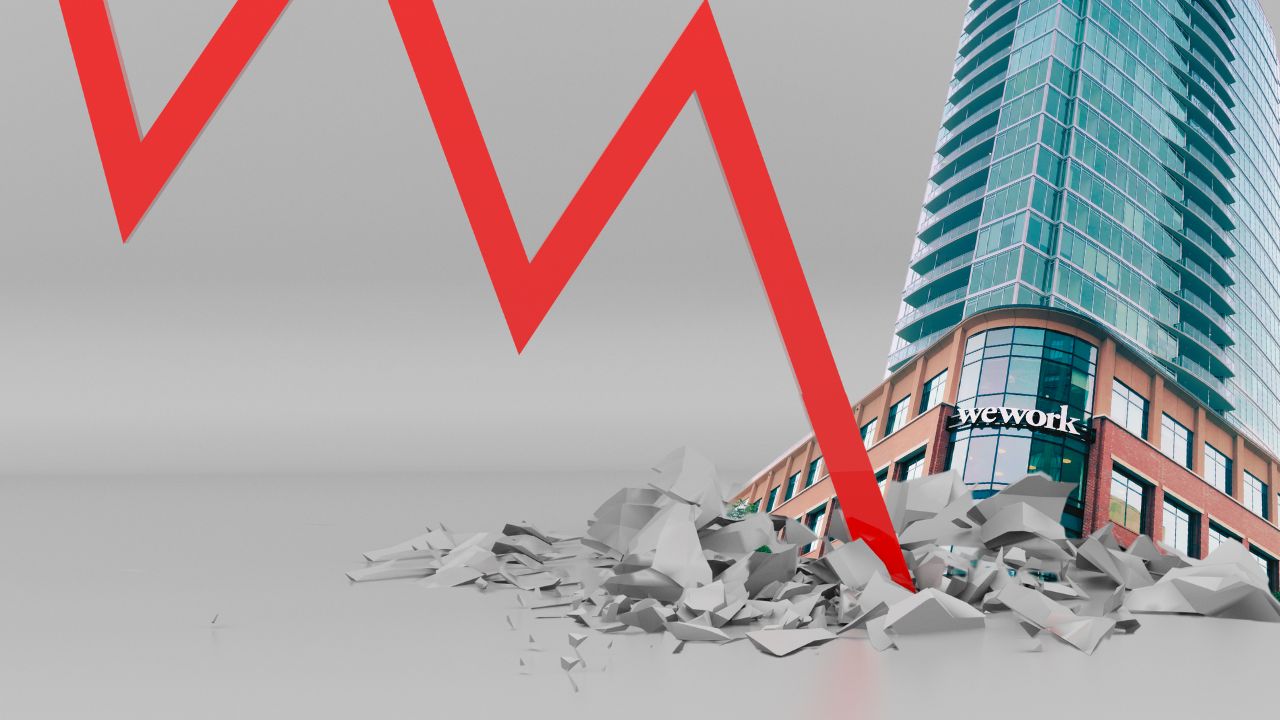
- Over the past year, WeWork Inc. shares have fallen from around $15.00 to around $5.00, down two-thirds, twice as much as the market average.
- Demand for flexible workspaces is eclipsing pre-pandemic levels and contract occupancy rates remained above pre-pandemic levels for the third consecutive quarter.
- When WeWork shares crashed, they fell from such a height that they did a lot of damage, especially to Softbank, its largest shareholder.
Over the past year, WeWork Inc. (WE) stock has traded from around $15.00 to around $5.00, a two-thirds drop, versus a one-third drop in the S&P; 500 over the same period. WE fell twice as far as the market average. Why?
By comparison, its main global rival, IWG plc (owner of the Regus and Spaces brands), fell by just under half. To be fair, however, IWG’s main listing is in London and the FTSE 100 is slightly higher than it was a year ago. So relative to each company’s core market, they’re about equal. Even bad, that is.
The other main coworking company Servcorp, listed on its Australian home market, is a bit below what it was a year ago, although it is up 50% in the past 52 weeks. Its market capitalization at £180m ($216m) makes it a minnow compared to IWG at £1.9bn ($2.28bn) and WE at £3.5bn (4 .2 billion dollars).
What do these falling stock prices mean for coworking?
You would think that stock price movements indicate a problem in the coworking space, but on the ground, business conditions remain positive. The UK’s leading agent in this sector, Douglas Green, has been in the business for more than 22 years than I have, so his views are worth considering.
Green recently posted his take on new research from Instant Group on LinkedIn and chose to highlight a number of key points:
- Demand for flexible workspaces is eclipsing pre-pandemic levels and contract occupancy rates remained above pre-pandemic levels for the third consecutive quarter. Facilities-rich spaces offer the highest occupancy rates: 82% compared to 74% in traditional spaces.
- Average prices are up — London West End office rates: £690 (+5% vs.. previous six months), City: £607 (+3%). In the regions: Liverpool: +17%, Cardiff: +6%, Bristol: +4%, Edinburgh: +11%, Leeds: +14%, Manchester: +4%
- The average price per private office in the UK was £525 in the first half of 2022, up 22% year-on-year, beating pre-Covid prices by 13%. Regional office rates hit £298, a 17% year-on-year increase
- There are now over 6,000 flexible workspaces in the UK, with a forecast of over 9,000 by 2026. This represents a growth of 50% in three years.
Douglas’ overall conclusion, with which I fully agree, was that “these data provide further evidence of the extraordinary growth of the Flex sector and are consistent with my previous prediction that the industry will double in size over the next five coming years”.
The data he cited is all from the UK, but I doubt it’s much different in the US market as the Covid effect is still pushing workers away from big cities. center offices in both countries.
The impact of the WeWork crash
So, again, why has WE stock price fallen so far? Part of the reason is that it had to drop further than IWG’s. Under its founder Adam Neumann’s leadership, WE’s stock price had risen to levels normally reserved for breakthrough tech giants. So when it crashed to earth, it fell from such a height that it did a lot of damage, especially to Softbank, its largest shareholder.
It would be logical to assume that if a big company bit the dust dramatically, its rivals would benefit, but that hasn’t happened with IWG. Maybe because the market wondered if there was something wrong with the business model itself? Guilt by association.
How do WeWork’s and IWG’s financials compare?
Turning now to finances, both companies were in the red at the end of 2021, but WE has never made a profit in its history and IWG was profitable before the pandemic hit. It will be interesting to compare their performance since the beginning of this year, once the market has had time to digest the interim figures from the IWG, which came out this week. In January 2022, their annual revenues were almost the same: $2.7 billion.
IWG used that revenue to make a gross profit of $292 million, but WE posted a loss of $515 million, illustrating one of the main issues facing the post-Neumann board – a inflated cost base.
To give it credit, the board managed to cut the 2020 maximum cost by half a billion, but it’s still 50% higher than IWG’s; future cost reductions will become increasingly difficult.
Unlike Adam Neumann, IWG’s Mark Dixon was probably never considered angelic, but he was a visionary in his own way — even if the vision was more prosaic than WeWork’s “raising world consciousness.” .
The latest manifestation of Dixon’s vision can be seen in the merger with Instant Group and daVinci Virtual, which I see as a recognition of the important role technology will play in the future as a driver of revenue and value for space providers.
If IWG can generate revenue and efficiencies through technology (as some of the smaller private companies in this space have done), it could be a game-changer that the franchise, its latest major initiative, hasn’t. been so far.
At the risk of repeating myself, I still see no justification for the market cap discrepancy. between WE and IWG. It didn’t surprise me that IWG was profitable in the first half of 2022, at least operationally; it is not conceivable that WE are.
Private equity firms have already looked at IWG, but so far none have made an offer. I’ll never really understand what they saw in WE under Adam Neumann, or why they find it so hard to get a deal with Mark Dixon.
